
GER Titan 500 Smart Detection Depth: Can It Really Reach 120 Meters?
The GER Titan 500 Smart Detector is a professional long range exploration device marketed for locating gold, precious metals, gemstones, and buried treasure. One of its most attention-grabbing specifications is its manufacturer-advertised maximum detection depth of 120 meters (approximately 394 feet).

But can the Titan 500 Smart detector really find gold buried 120 meters underground? Does that depth apply to small gold nuggets, large treasure caches, or every target type? And what is the difference between a manufacturer's advertised maximum depth and independently verified detection performance?
These are important questions for anyone considering an investment in a professional gold detector.
In this guide, we'll examine the GER Titan 500 Smart's advertised detection depth, explain the factors that affect underground exploration, compare long-range depth claims with conventional metal detection, and discuss what buyers should verify before purchasing.
The key distinction is simple: 120 meters is a manufacturer-advertised maximum, not a guarantee that every buried target can be detected at that depth.
1. What Is the GER Titan 500 Smart Detector?
The GER Detect Titan 500 Smart is a portable, multi-system long range exploration device developed by GER Detect.
According to the manufacturer's published specifications, it is designed for exploring potential underground targets such as gold, precious metals, diamonds, gemstones, and buried treasures.
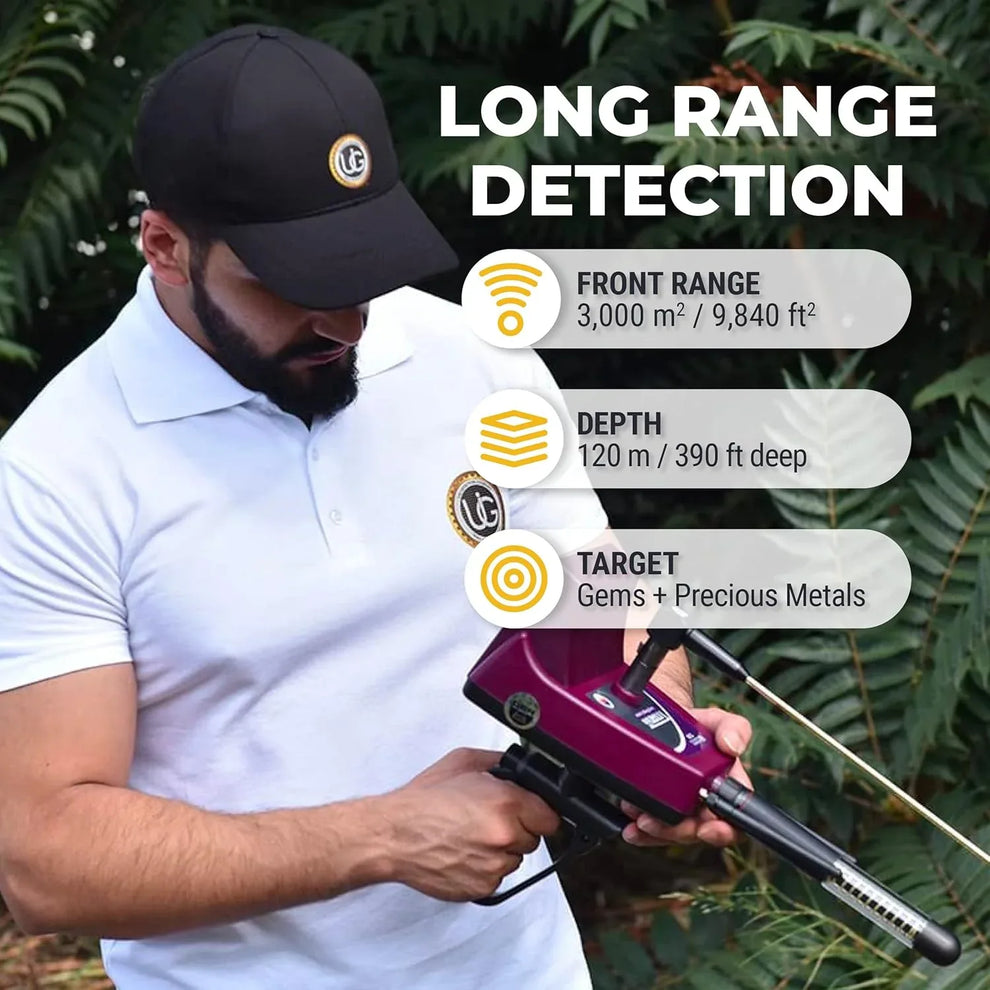

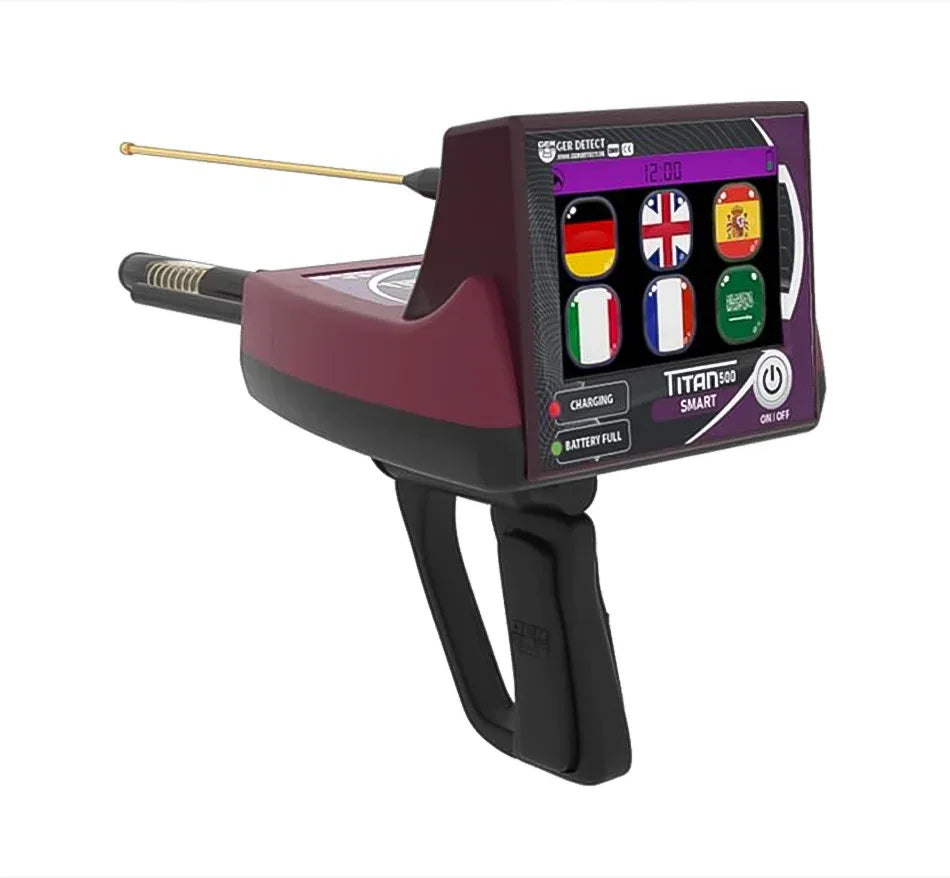
GER Titan 500 Smart Detector Specifications
|
Specification |
Manufacturer's Published Figure |
|---|---|
|
Maximum advertised search depth |
Up to 120 meters |
|
Maximum advertised forward range |
Up to 3,000 meters |
|
Search systems |
4 |
|
Soil profiles |
Selectable |
|
Depth analysis |
Included |
|
Languages |
6 |
|
Weight |
6 kg |
|
Warranty |
2 years |
These specifications appear in GER Detect's official product information. They describe the manufacturer's intended capabilities and should not be mistaken for results from an independent field trial.
2. Can the Titan 500 Smart Detector Really Detect Gold at 120 Meters?
The manufacturer claims the Titan 500 Smart can search to depths of up to 120 meters. However, publicly available specifications do not establish that it can reliably detect gold at that depth under controlled, independently verified conditions.
There are three important distinctions buyers should understand.
Manufacturer-Advertised Maximum Depth
The 120-meter figure represents GER Detect's published maximum search-depth specification.
It is not accompanied, in the product specifications reviewed, by a standardized test showing detection probabilities at that depth for specified gold targets, sizes, and geological conditions.
Independently Verified Detection Depth
A verified detection depth would require a controlled experiment in which the detector consistently identifies an unknown buried target without the operator knowing its location.
Such testing should document the target material, size, burial depth, ground conditions, equipment settings, and false positive results.
Actual Field Performance
Real-world results can differ significantly from advertised specifications.
A claimed maximum should never be interpreted as a promise that the detector can locate a gold coin, small nugget, or buried treasure chest at 120 meters.
The appropriate conclusion is that 120 meters is an advertised capability that requires independent verification, rather than an established detection depth.
3. What Affects Gold Detection Depth?
Even with established electromagnetic metal detection technologies, detection depth is not a fixed number.
Several factors can affect whether a buried metallic target can be identified.
Target Size and Mass
A small gold nugget and a large concentrated metallic object present very different detection challenges.
Larger conductive targets can produce stronger responses under suitable electromagnetic detection conditions, but this does not validate extreme-depth claims made for long-range locators.
Target Composition
Gold, silver, copper, iron, and other metals have different electrical and magnetic properties.
However, a selectable gold mode or a target label on a screen does not by itself prove that an instrument can chemically identify buried gold.
Soil Mineralization
Iron-rich soils, magnetite, hot rocks, salts, and other geological materials can complicate instrument measurements.
For conventional detectors, mineralized ground can increase noise or reduce sensitivity. The effect on any specific system depends on its actual sensing principle.
Target Depth and Orientation
The deeper a target is buried, the more difficult it generally becomes to obtain a reliable signal with conventional electromagnetic detection.
Its shape and orientation can also influence the response.
Search Method and Operator Technique
Consistent search patterns, correct instrument setup, repeated measurements, and accurate recordkeeping can improve the quality of an investigation.
But operator skill cannot compensate for a detection principle that has not been scientifically demonstrated.
4. How Does the Titan 500 Smart Detector Estimate Target Depth?
GER Detect lists a dedicated depth-determination and results-analysis system among the Titan 500 Smart's four operating systems.
According to the manufacturer, this function analyzes a detected target and provides depth information in meters and centimeters.
This is a feature description, not independent proof of depth-measurement accuracy.
To establish accuracy, an operator would need to compare the displayed depth with known burial depths across multiple concealed targets and geological environments.
Estimated Depth vs. Confirmed Depth
Suppose an instrument displays a suspected target at 15 meters.
That result is an instrument estimate. It does not independently establish that a metallic target exists at 15 meters or that the target is gold.
The same principle applies to much larger estimates, including 60, 100, or 120 meters.
For serious exploration, depth estimates should be treated as hypotheses requiring verification.
5. Understanding the Titan 500 Smart's Four Search Systems
The Titan 500 Smart detector includes four manufacturer-described search systems.
|
Search System |
Intended Application |
|---|---|
|
Gold and precious metals |
Exploring for gold and other selected metals |
|
Gemstones |
Searching for selected gemstone categories |
|
Diamonds |
Manufacturer-described diamond exploration |
|
Depth determination |
Estimating depth and analyzing target indications |
GER Detect markets these systems as part of its long-range exploration platform.
An important distinction is that these four systems are not equivalent to four independently established electromagnetic detection methods.
For example, the manufacturer describes the detector as capable of selecting different metal and gemstone categories. However, selecting a target category is not the same as scientifically demonstrating that the device can distinguish buried gold from other materials.
Buyers should evaluate each system according to its actual operating principle and independently documented performance.
6. Titan 500 Smart Detection Depth vs. Search Range: What's the Difference?
Two specifications often appear together in Titan 500 Smart product descriptions:
Advertised maximum depth
120 m
Vertical depth below the surface
Advertised maximum range
3,000 m
Horizontal forward search distance
The manufacturer's specifications describe a maximum forward range of 3,000 meters and allow selectable range settings from 100 to 3,000 meters.
These figures refer to different dimensions.
-
Search depth refers to how far beneath the surface a target is claimed to be detectable.
-
Search range refers to how far away from the operator a target is claimed to be detectable.
Neither specification demonstrates detection accuracy by itself.
For example, setting the forward search range to 1,000 meters does not establish that the detector can locate a gold target at that distance.
7. Can the Titan 500 Smart Detect Small Gold Nuggets at Great Depth?
Small natural gold nuggets are a particularly demanding target.
A tiny nugget contains relatively little metal and may be surrounded by highly mineralized soil, iron-bearing rocks, or other sources of interference.
GER Detect includes raw gold and gold nuggets among the targets advertised for the Titan 500 Smart. However, the published maximum depth of 120 meters should not be interpreted as a verified detection depth for small nuggets.
What About Fine or Flour Gold?
Fine gold particles dispersed throughout sand, gravel, or bedrock present a different problem from a single concentrated metallic object.
A long-range target indication does not establish the presence or grade of fine gold deposits.
For fine gold exploration, systematic sampling, panning, concentration, and laboratory assays provide more defensible evidence.
What Technology Is Better for Small Gold Nuggets?
For direct nugget hunting, specialized high-frequency VLF and gold-focused Pulse Induction detectors are generally more appropriate starting points because their electromagnetic detection principles are established and their performance can be evaluated using known targets.
The Titan 500 Smart should not be assumed to outperform these technologies simply because it advertises a much greater maximum search depth.
8. Can the Titan 500 Smart Find Deep Buried Treasure?
Deep treasure hunting often involves questions about larger buried metallic objects, old caches, historical artifacts, and suspected underground storage locations.
The Titan 500 Smart is marketed for this type of exploration.
However, whether it can reliably detect a specific buried treasure target—and at what depth—remains a question that requires controlled testing.
Historical research and site investigation
Systematic survey and documented measurements
Repeat suspected target indications
Independent verification using appropriate technology
Evaluate excavation feasibility, safety, and permissions
This approach reduces the risk of interpreting an uncertain instrument response as definitive evidence of treasure.
9. Does the Titan 500 Smart Work in Mineralized Soil?
GER Detect provides selectable soil settings, including clayey, mineralized, natural, mixed, sandy, and rocky ground.
The manufacturer also markets the detector for challenging terrain and mineral-rich environments.
These settings may help users configure the device according to its operating instructions.
However, having a mineralized-soil setting does not independently establish accurate target detection in highly mineralized ground.
For example, a buyer planning to search in iron-rich terrain should request testing conducted in comparable soil conditions, rather than relying on a general claim that the device works in all soil types.
10. How to Evaluate the Titan 500 Smart's 120-Meter Claim
The most useful way to assess an extraordinary detection-depth claim is through a controlled, blinded field test.
Use gold or another clearly identified target of documented size and mass.
Prevent the operator from knowing where the target is buried.
Include locations with no target to measure false positives.
Record the actual depth independently.
Repeat the experiment with randomized target placements.
Record the settings, ground conditions, and operator technique.
Have a qualified third party oversee and document the results.
The detector should correctly identify concealed targets at a rate meaningfully above chance while maintaining an acceptable false-positive rate.
This is particularly important for long-range locators, whose claimed distant material-identification mechanisms have not been reliably demonstrated through independent blind testing as a class. That broader concern is not itself a device-specific test of the Titan 500 Smart.
Questions to Ask Before Purchasing
Ask the supplier whether they can provide independent controlled-test reports, videos showing genuinely blind target-location trials, documented target dimensions and depths, and information about the detector's underlying sensing technology.
A promotional demonstration involving a previously known target location is not equivalent to a controlled blind test.
11. Titan 500 Smart vs. Conventional Deep-Seeking Metal Detectors
The Titan 500 Smart is marketed primarily as a long-range exploration system. Conventional deep-seeking metal detectors generally use established electromagnetic induction principles.
|
Feature |
Titan 500 Smart |
Conventional Deep-Seeking Metal Detector |
|---|---|---|
|
Primary approach |
Manufacturer-described long-range exploration |
Electromagnetic target detection |
|
Advertised maximum depth |
Up to 120 m |
Depends on detector, coil, and target |
|
Forward search range |
Up to 3,000 m advertised |
Typically requires surveying the ground with a coil or sensor |
|
Target selection |
Manufacturer-described material categories |
Conductivity-based responses or discrimination, depending on model |
|
Small gold nuggets |
Performance not independently established |
Specialized models available |
|
Testing |
Requires controlled validation of advertised claims |
Can be evaluated using concealed metallic targets |
|
Best purchasing consideration |
Verify long-range claims |
Match detector and coil to target and terrain |
A conventional detector with a smaller advertised detection depth may be the more appropriate tool for a particular task if its performance is demonstrated on the actual target type.
The correct choice depends on the search objective, not simply the largest number on a specification sheet.
12. Is the GER Titan 500 Smart Detector Worth Buying?
However, buyers should distinguish these product features from demonstrated detection capability.
The most important purchasing question is not simply whether the detector advertises a 120-meter maximum depth.
It is whether the device can reliably detect the types of targets you intend to search for, under realistic conditions, with independently verifiable results.
For buyers primarily interested in small gold nuggets, established gold-focused VLF or PI detectors deserve serious consideration. For deeper geological or structural investigations, appropriately selected geophysical equipment may be more suitable.
13. Frequently Asked Questions About Titan 500 Smart Detection Depth
Can the GER Titan 500 Smart really detect 120 meters deep?
GER Detect advertises a maximum search depth of 120 meters. However, the publicly available manufacturer specifications reviewed do not establish that this depth has been independently verified through controlled blind testing.
How far can the Titan 500 Smart detector search?
The manufacturer advertises a forward search range of up to 3,000 meters, with selectable range settings. This is a claimed capability, not a guaranteed target-detection distance.
Can the Titan 500 Smart detect small gold nuggets?
The manufacturer lists raw gold and gold nuggets among its intended targets, but reliable detection performance for small nuggets has not been established by the advertised maximum-depth figure.
Does the Titan 500 Smart identify gold underground?
GER Detect describes selectable metal categories. However, choosing a gold mode or receiving a target indication does not independently confirm that the buried material is gold.
Does the Titan 500 Smart have 3D ground scanning?
The manufacturer's published specifications describe long-range search and depth-analysis functions. They do not list a dedicated 3D ground-imaging mode comparable to a separately documented geophysical imaging system.
Can the Titan 500 Smart work in highly mineralized soil?
It offers selectable soil profiles, including mineralized ground. Actual detection reliability in difficult soil should be established through appropriate testing.
Is the Titan 500 Smart better than a Pulse Induction gold detector?
Not universally. For direct detection of metallic targets, particularly natural gold nuggets, a specialized PI detector may be more appropriate. The best choice depends on the target and field conditions.
Final Verdict: Can the Titan 500 Smart Really Reach 120 Meters?
The GER Titan 500 Smart Detector has a manufacturer-advertised maximum search depth of 120 meters and a maximum forward search range of 3,000 meters.
Those specifications explain why the device attracts attention among buyers researching professional gold detectors and deep buried treasure exploration.
However, there is an important difference between an advertised capability and independently demonstrated field performance.
The available product documentation does not establish that the Titan 500 Smart can consistently locate concealed gold targets at 120 meters under controlled conditions.
Before investing, consider your target size, terrain, intended application, and available verification methods. Request documented testing and evaluate whether a conventional metal detector or geophysical instrument may better serve your project.
The most meaningful measure of a gold detector is not its maximum advertised depth, but its ability to produce accurate, repeatable, independently verifiable results.


