
1. GER Titan 500 vs. Gold Step Pro Max: Quick Comparison

GER Detect Titan 500 Smart
Long-range-focused exploration

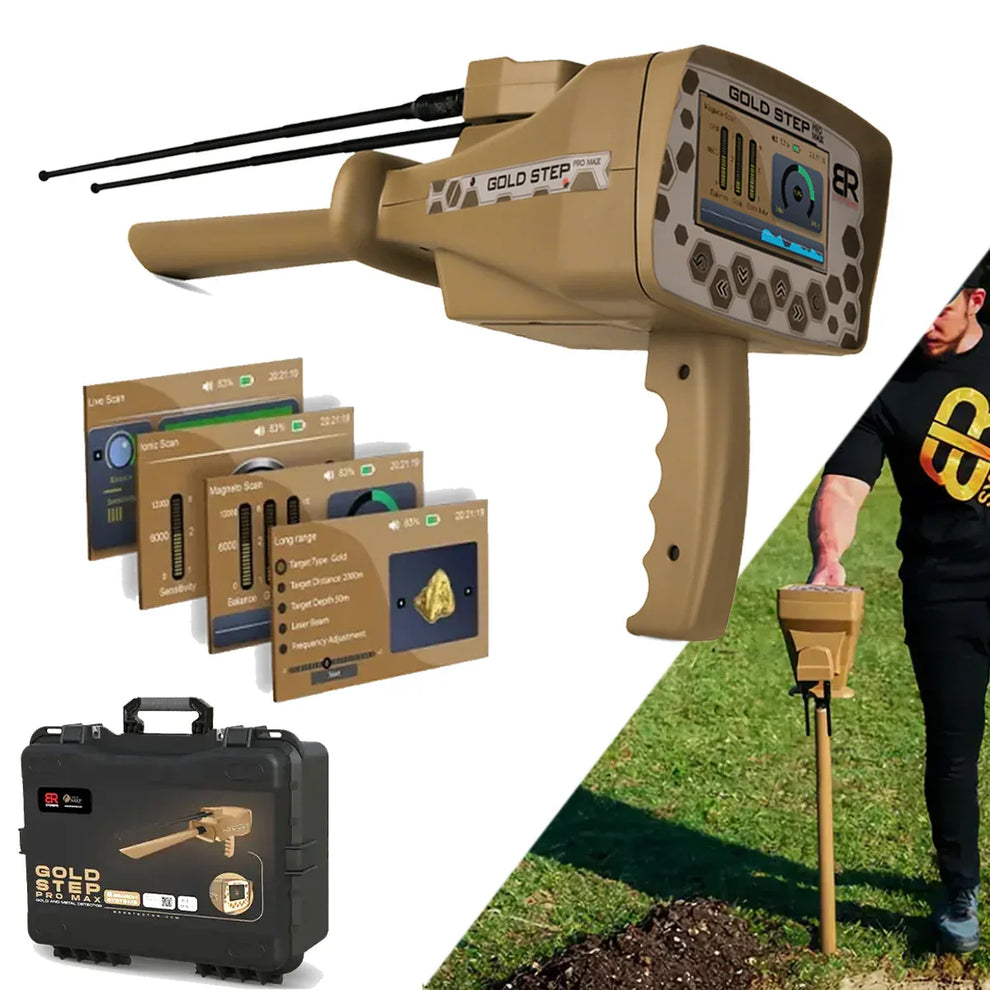
BR Systems Gold Step Pro Max
Long-range and multi-stage scanning
The following figures are manufacturer-advertised specifications, not independently verified detection performance.
| Feature | GER Titan 500 Smart | Gold Step Pro Max |
|---|---|---|
| Search systems | 4 | 5 |
| Primary application | Long-range exploration | Long-range and detailed scanning |
| Long-range search | Yes | Yes |
| Advertised maximum search distance | Up to 3,000 m | Up to 2,000 m |
| Advertised maximum long-range depth | Up to 120 m | Up to 50 m |
| 3D ground scanning | No | Yes |
| Advertised 3D scanning depth | Not applicable | Up to 16 m |
| Live scanning | No dedicated mode listed | Yes |
| Magnetic scanning | No dedicated mode listed | Yes |
| Ionic search | No dedicated mode listed | Yes |
| Target selection | Yes | Yes |
| Soil settings | Selectable soil profiles | Automatic calibration |
| Cavity investigation | Not a primary feature | Supported scanning application |
| Main advantage | Long-range-focused feature set | Multiple investigation methods |
← Swipe left or right to view the full comparison table →
These differences make each detector suitable for a different exploration strategy. Importantly, the advertised depths are associated with different search systems and should not be treated as directly comparable measurements.
2. Search Technologies: Four Systems vs. Five Systems
One of the biggest differences between these detectors is how their manufacturers organize their search technologies.
GER Titan 500 Smart: Four Search Systems
The Titan 500 Smart is designed around four manufacturer-described systems covering gold and precious metals, gemstones, diamonds, and target-depth analysis.
Its primary appeal is its long-range exploration approach. Operators can select search categories and soil settings according to the manufacturer's procedures.
This configuration may appeal to customers whose main objective is exploring a large property and narrowing their search toward potential targets.
However, its four systems should not be confused with four independent conventional metal detection technologies.
BR Systems Gold Step Pro Max: Five Search Systems
The Gold Step Pro Max incorporates five manufacturer-described systems:
- 3D Ground Scan
- Live Scan
- Ion Search
- Magneto Scan
- Long Range Locator
This gives the operator several methods for investigating a location.
For example, an operator might begin with wide-area exploration, identify a potential search zone and then use the scanning systems to collect additional information.
The important distinction is that having more systems does not automatically establish better detection accuracy.
3. Long-Range Detection: Which Detector Covers More Ground?
Long-range exploration is a major selling point for both devices.
GER Detect advertises a forward search range of up to 3,000 meters for the Titan 500 Smart. Its operating system also allows users to select search distances according to the manufacturer's instructions.
BR Systems advertises up to 2,000 meters for the Gold Step Pro Max's long-range system.
Based strictly on the published specifications, the Titan 500 offers the greater claimed horizontal search distance.
However, a larger advertised range does not automatically mean better detection accuracy.
Long-range detection is a controversial category, and extraordinary range or material-identification claims require independent, controlled testing. Buyers should distinguish manufacturer specifications from demonstrated performance.
For large properties, historical treasure sites or remote exploration areas, consider the complete search strategy rather than relying on maximum range alone.
The Titan 500 advertises a greater search distance, while the Gold Step Pro Max offers additional scanning modes for investigating a defined area. Neither advantage establishes that the device can reliably locate gold.
4. Detection Depth: 120 Meters vs. 50 Meters
Manufacturer-Advertised Maximum Depths
Different operating systems; not independently verified or directly comparable.
Visual comparison of manufacturer-advertised maximum figures only. These figures represent different operating systems and should not be interpreted as equivalent real-world detection tests.
GER Detect states that the Titan 500 Smart has a maximum search depth of up to 120 meters.
BR Systems advertises a maximum depth of 50 meters for the Gold Step Pro Max's long-range system. Its 3D Ground Scan, Live Scan and Magneto Scan systems have separately advertised maximum depths of 16 meters.
Does this mean the Titan 500 is the more powerful detector?
Not necessarily.
Maximum-depth specifications require several important qualifications:
- Target size: A large concentrated metallic object presents a different detection challenge from a tiny gold nugget.
- Operating system: Long-range depth claims cannot automatically be compared with conventional metal detection or geophysical scanning depths.
- Ground conditions: Soil composition, mineralization and geological structure can influence instrument measurements.
- Verification: An advertised maximum is not equivalent to an independently demonstrated result.
A selectable depth setting is also not proof that an object has been detected at the selected depth.
Before choosing either device, request documented demonstrations involving realistic targets and independent verification.
5. 3D Ground Scanning: The Gold Step Pro Max's Biggest Feature Difference

One of the most significant differences between these devices is the Gold Step Pro Max's integrated 3D Ground Scan system.
According to BR Systems, this mode is designed to investigate precious and non-precious metals, voids and caves. The manufacturer states that operators can examine the resulting visualization directly on the device's display.
The Titan 500 Smart does not include a comparable dedicated 3D ground-imaging system in its published specifications.
For someone investigating a suspected underground chamber or anomaly, the Gold Step Pro Max therefore offers an additional manufacturer-described feature.
A 3D visualization should not be confused with an underground photograph.
Colors, shapes and other graphical information represent instrument data interpreted by software. Without an adequately documented measurement method and independent verification, these images cannot establish that an anomaly is gold.
A responsible investigation requires repeatable measurements and appropriate secondary methods.
6. Live Scan and Magneto Scan: Additional Investigation Methods
The Gold Step Pro Max includes two additional systems that distinguish it from the Titan 500 Smart.
Live Scan
BR Systems describes Live Scan as a real-time scanning method intended to investigate metallic targets and underground voids.
The manufacturer advertises a maximum depth of 16 meters for this mode.
For an operator investigating a defined location, live scanning offers an additional way to examine instrument responses before deciding whether more detailed investigation is warranted.
Magneto Scan
The Gold Step Pro Max also includes a dedicated Magneto Scan mode, with a manufacturer-advertised depth of up to 16 meters.
An important scientific distinction applies here: gold is not ferromagnetic.
A magnetic anomaly may arise from iron-bearing material, geological variations or other magnetic sources. It should never automatically be interpreted as evidence of buried gold.
The usefulness of this mode depends on the underlying sensor, measurement method and geological environment.
7. Ionic Search and Target Selection
Both manufacturers promote target-specific exploration, although their systems differ.
The Titan 500 Smart includes selectable categories for gold, precious metals, gemstones and diamonds. GER Detect also describes a separate depth-determination and analysis system.
The Gold Step Pro Max includes an Ion Search mode, which BR Systems markets for investigating long-buried precious-metal targets.
BR Systems advertises up to 1,000 meters of search distance and 20 meters of depth for this particular mode.
These features should be interpreted carefully.
Selecting a gold search mode does not demonstrate that an instrument can uniquely identify gold underground. Likewise, claims concerning ionic emissions from buried precious metals require independent scientific validation.
The actual composition of a suspected target must be established through appropriate verification.
8. Soil Conditions and Mineralized Ground
Ground conditions deserve careful attention when comparing professional gold exploration equipment.
Gold-bearing environments may contain magnetite, iron oxides, black sand, clay, salts and other materials that complicate instrument measurements.
GER Detect provides selectable soil profiles on the Titan 500 Smart, including clayey, mineralized, natural, mixed, sandy and rocky ground.
BR Systems describes automatic ground calibration for the Gold Step Pro Max.
Titan 500 Smart
Operator-selected soil settings.
Gold Step Pro Max
Manufacturer-described automatic calibration.
Neither feature, by itself, establishes reliable gold detection in highly mineralized ground.
If mineralization is a major concern, request field-testing information for the exact system and geological conditions involved.
For direct detection of natural gold nuggets, a specialized VLF or Pulse Induction detector may be a more appropriate choice.
9. Which Detector Is Better for Gold Nuggets?
This question is particularly important for natural gold prospectors.
Although both manufacturers market their equipment for gold exploration, neither device should automatically be considered a substitute for a specialized nugget detector.
Finding a tiny natural gold nugget requires sensitivity to a small metallic target, along with suitable ground handling.
Conventional gold-focused VLF and PI detectors have established electromagnetic detection principles and are designed for this kind of work.
The Titan 500 and Gold Step Pro Max are primarily marketed around broader exploration and multiple search methods.
For small natural nuggets, compare dedicated nugget detectors before investing in either system.
What About Fine or Flour Gold?
Fine alluvial gold creates an additional challenge.
A kilogram of gold concentrated into one metallic object is fundamentally different from a kilogram dispersed as microscopic particles throughout many tons of gravel.
Neither the Titan 500 nor the Gold Step Pro Max has demonstrated that it can reliably identify fine disseminated gold through its advertised long-range capabilities.
For this application, systematic sampling, panning, concentration and laboratory assays are more appropriate methods.
10. Which Detector Is Better for Cavities, Tunnels and Underground Structures?
The Gold Step Pro Max has the more relevant published feature set for this application.
BR Systems explicitly includes voids and caves among the intended targets of its 3D Ground Scan, Live Scan and Magneto Scan systems.
By comparison, the Titan 500 Smart's published search systems concentrate on gold, metals, gemstones, diamonds and depth analysis.
However, investigating a suspected underground cavity is different from conclusively locating or mapping one.
For projects involving tunnels, buried chambers or structural hazards, established geophysical methods such as appropriate ground-penetrating radar or electrical resistivity surveys may be preferable.
The best method depends on target dimensions, depth, soil conductivity and geological conditions.
11. Ease of Use: Focused Exploration vs. Multiple Scanning Methods
Another practical consideration is the amount of equipment training required.
The Titan 500 Smart offers a relatively focused operating structure built around target categories, long-range settings, soil selection and depth analysis.
The Gold Step Pro Max introduces additional scanning methods that may require more time to learn.
Operators using multiple scanning systems should understand how to:
- Establish a consistent survey area.
- Follow the manufacturer's calibration procedures.
- Repeat measurements.
- Document suspected anomalies.
- Recognize possible environmental interference.
- Avoid interpreting every graphical response as a valuable target.
Having additional systems is useful only when those systems produce meaningful information that the operator can interpret correctly.
12. Which Detector Should You Choose?

Consider the GER Titan 500 Smart
Its published feature set is more closely aligned with buyers interested in long-range-focused exploration, selectable target categories, soil profiles and manufacturer-described depth analysis.
Consider the BR Systems Gold Step Pro Max
Its broader feature set may appeal to buyers interested in combining long-range exploration with additional 3D, live and magnetic scanning modes.
These recommendations describe the manufacturers' published features. They are not conclusions about independently demonstrated gold-finding performance.
For either device, request a controlled demonstration with realistic targets before making a purchasing decision.
If your primary goal is small-nugget prospecting, consider a dedicated gold detector instead.
13. Frequently Asked Questions
Is the GER Titan 500 more powerful than the Gold Step Pro Max?
Not necessarily. The Titan 500 has greater manufacturer-advertised maximum range and depth figures, while the Gold Step Pro Max includes additional scanning systems. These specifications alone do not establish which detector performs better in real-world conditions.
Does the Titan 500 have 3D ground scanning?
No dedicated 3D ground-imaging mode is listed in GER Detect's published specifications for the Titan 500 Smart.
Can the Gold Step Pro Max detect underground cavities?
BR Systems markets its scanning systems for investigating voids and caves. However, these capabilities and their accuracy should be evaluated through documented testing.
Can either detector identify gold without excavation?
Neither manufacturer's target-selection features should be treated as definitive chemical identification. Suspected gold requires independent confirmation.
Which detector is better for highly mineralized soil?
There is insufficient independent comparative testing to establish a winner. The most appropriate technology depends on the actual target and geological conditions.
Are the advertised maximum depths guaranteed?
No. The published figures are manufacturer claims and should not be interpreted as guaranteed performance for every target or search environment.
Final Verdict: GER Titan 500 vs. Gold Step Pro Max
The biggest difference between these detectors is not their advertised maximum depth. It is their approach to exploration.
The GER Titan 500 Smart concentrates on long-range exploration, selectable target categories, soil settings and manufacturer-described depth analysis.
The BR Systems Gold Step Pro Max offers a broader selection of operating modes, combining long-range searching with 3D Ground Scan, Live Scan, Magneto Scan and Ion Search.
For buyers who specifically want those additional scanning features, the Gold Step Pro Max has the broader published feature set.
For buyers primarily interested in a long-range-focused platform, the Titan 500 offers a more concentrated selection of functions and greater advertised maximum range.
However, neither device should be selected solely on the basis of its advertised depth, number of systems or claims of identifying precious metals underground.
The most important questions remain: What are you searching for? What is the expected target size? What geological conditions are present? And how will you independently verify a suspected target?
Choose the equipment that addresses your actual exploration problem—not simply the detector with the biggest numbers.


